EN
Marjolein Witte (1979)
Marjolein Witte is a multidisciplinary artist who studied at the Utrecht School of the Arts (HKU). Her work consists of sculptures, installations, paintings, and photographs made using wood, paint, plants, seeds, text, and graphic patterns. Witte explores the complex relationships between people and places, objects, nature, and others. A sense of home and the act of occupying space are recurring themes in her work. Interactivity and collaboration play an increasingly important role in her practice.
Home
I clearly remember how, as a nine-year-old girl, I suddenly had to leave my home, school, and village. The year that followed, I experienced an intense homesickness. Homesickness: a strong longing for home. As humans, we all develop a “sense of place”: we connect places with memories, ideas, people, and cultures. Everyone longs for a place of their own on earth—not only a physical place, but also one where you feel attachment and connection.
According to philosopher Gaston Bachelard (1884–1962), the house is our first universe, the place where our life begins. It offers physical protection, and when it truly becomes a home, it allows us to be ourselves. I see home as the ultimate place for self-expression. Through a collection of objects, we shape our “narrative self.” Objects carry stories through which we try to understand the world and ourselves. The house, with all its corners and objects, helps us remember and dream.
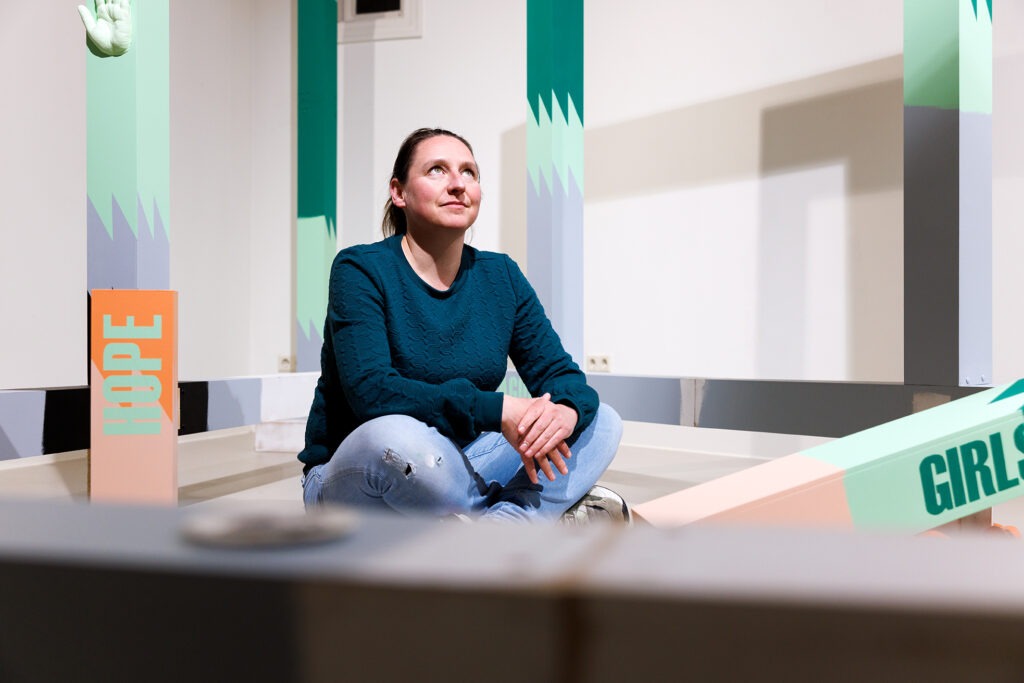
My recent installations are inspired by houses under construction and root architecture: angular, space-following beam structures in which I use domestic objects and text, weaving personal experiences together with site-specific stories. Within the small, the personal, and the local, something universal is always present.
Space
After a teacher told me that I made myself invisible and did not take up space, I began to reflect. What concealment strategies was I using? And could I reveal myself and actually take up space? How does this manifest in individuals and groups? The evolutionary urge to appropriate space and demarcate territory takes many forms: we build, frame, parade, shout, and fight. Every day, we determine our position on both micro and macro levels.
I am fascinated by the human need to occupy space. With angular, barricade-like sculptures, I occupy spaces, investigate strategies for claiming space, and explore my relationship to others. In doing so, I use tactics such as adapting, standing out, and shielding. The sculpture functions as a stand-in for myself.
Relational Space
Space is more than dimensions, materials, and constructions. Geographer Doreen Massey (1944–2016) viewed space as relational: shaped by the stories of different people and groups over time. Origin, gender, memories, and personal perception influence how space is experienced. Those who look beyond physical boundaries discover a layered world. “The local is the global,” Massey stated. Through a site-specific approach and by bringing together different stories, I aim to make this layered nature visible.
NL
Marjolein Witte (1979)
Marjolein Witte is multidisciplinair kunstenaar en studeerde aan de Hogeschool voor de Kunsten Utrecht (HKU). Haar werk bestaat uit sculpturen, installaties, schilderijen en foto’s, gemaakt met hout, verf, planten, zaden, tekst en grafische patronen. Witte onderzoekt de complexe relaties van mensen met plaatsen, objecten, natuur en de ander. Thuisgevoel en het innemen van ruimte zijn terugkerende thema’s. Interactiviteit en samenwerking spelen een steeds grotere rol in haar praktijk.
Thuis
Ik herinner me nog goed hoe ik als negenjarig meisje plots mijn huis, school en dorp moest verlaten. Het jaar daarop voelde ik een intense heimwee. Heimwee: het sterke verlangen naar (t)huis. Als mensen ontwikkelen we allemaal een ‘sense of place’: we verbinden plaatsen met herinneringen, ideeën, mensen en culturen. Iedereen verlangt naar een eigen plek op aarde; niet alleen fysiek, maar ook waar je gehechtheid en verbinding voelt.
Volgens filosoof Gaston Bachelard (1884–1962) is het huis ons eerste universum, de plek waar ons leven begint. Het biedt fysieke bescherming, en wanneer het ook werkelijk een thuis is, kunnen we er onszelf zijn. Ik beschouw thuis als de ultieme plek voor zelfexpressie. Met een verzameling objecten geven we vorm aan ons ‘narratieve zelf’. Objecten dragen verhalen waarmee we de wereld en onszelf proberen te begrijpen. Het (t)huis, met al zijn hoeken en voorwerpen, helpt ons te herinneren en te dromen.
Mijn recente installaties zijn geïnspireerd op huizen in opbouw en wortelarchitectuur: hoekige, ruimte-volgende balkenconstructies waarin ik huiselijke objecten en tekst gebruik en persoonlijke ervaringen verweef met plaatsgebonden verhalen. In het kleine, persoonlijke en lokale schuilt altijd iets universeels.
Ruimte
Nadat een docent mij vertelde dat ik mij onzichtbaar maakte en geen ruimte innam, ging ik bij mezelf te rade. Welke verhultechnieken gebruikte ik? En kon ik mijzelf ónthullen en wel ruimte innemen? Hoe uit zich dit bij individuen en groepen? De evolutionaire drang om ruimte toe te eigenen en territorium af te bakenen kent vele vormen: we bouwen, kaderen, paraderen, roepen en vechten. Dagelijks bepalen we onze positie op micro- en macroniveau.
Ik heb een fascinatie voor de menselijke behoefte om ruimte in te nemen. Met hoekige, barricade-achtige sculpturen tast ik ruimtes af, onderzoek ik strategieën om ruimte te claimen en verken ik mijn relatie tot de ander. Daarbij maak ik gebruik van tactieken als aanpassen, opvallen en afschermen. De sculptuur fungeert hierbij als een stand-in voor mijzelf.
Relationele ruimte
Ruimte is meer dan afmetingen, materialen en constructies. Geograaf Doreen Massey (1944–2016) beschouwde ruimte als relationeel: gevormd door verhalen van verschillende mensen en groepen door de tijd heen. Afkomst, gender, herinneringen en persoonlijke waarneming beïnvloeden hoe ruimte wordt ervaren. Wie voorbij de fysieke grenzen kijkt, ontdekt een gelaagde wereld. “The local is the global,” aldus Massey. Met een site-specifieke aanpak en het samenbrengen van uiteenlopende verhalen probeer ik deze gelaagdheid zichtbaar te maken.